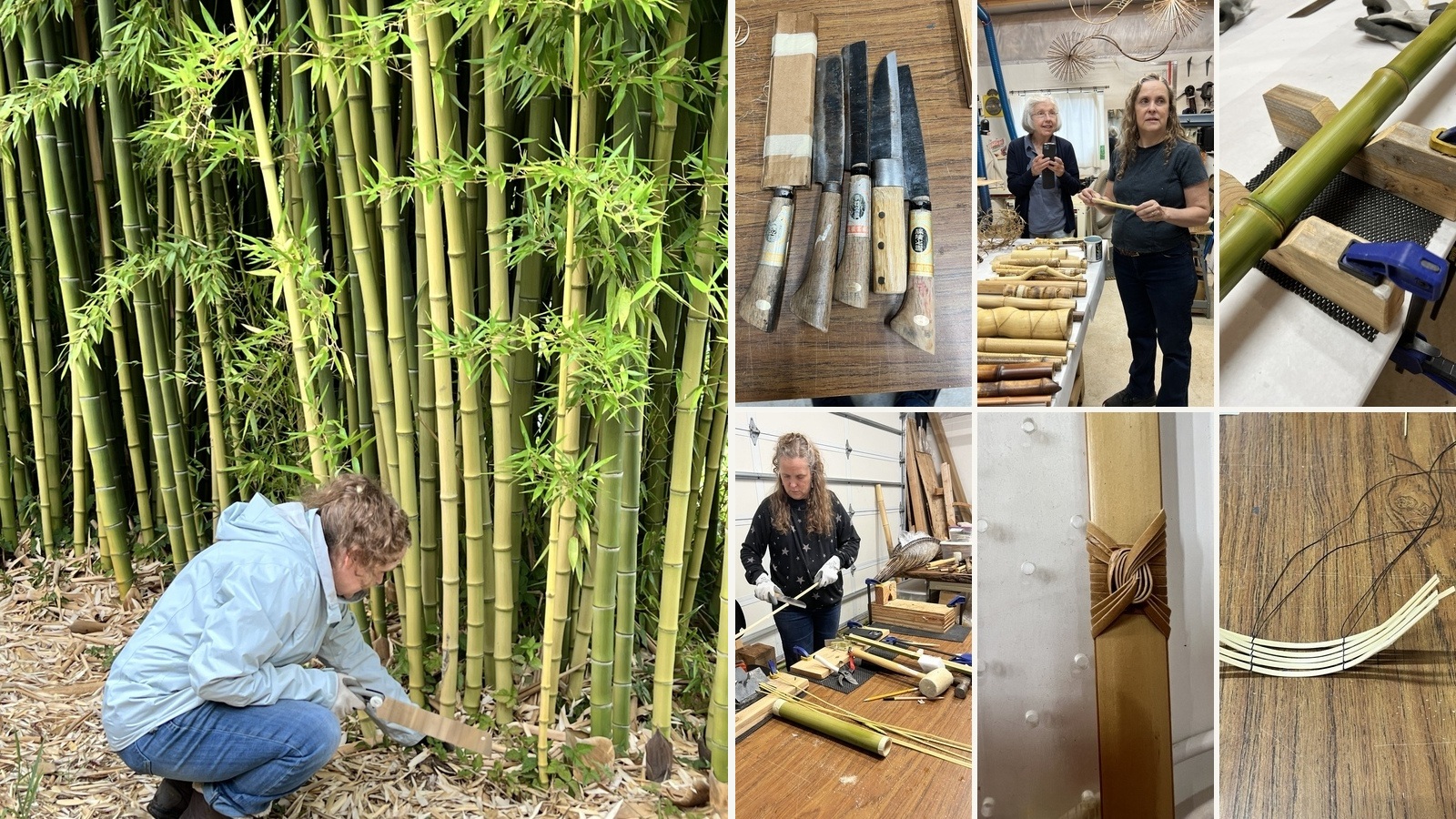
At the end of August, I traveled to Oregon for a multi-day bamboo class with Charissa. I have worked with bamboo before, but I wanted to understand the material more fully and learn techniques that could expand the way I use it in my own work.
I made a decision before the class began: I was not going to pressure myself to complete a finished piece. Traveling home with large bamboo constructions would have been difficult, and I wanted to use the time to concentrate on techniques. For me, that became the right choice.
Beginning with the bamboo itself
Our first day included a visit to Bamboo Gardens USA. We learned about different types of bamboo, how they grow and how to harvest them responsibly without damaging the health of the grove.
We also reviewed tools and safety before cutting our own canes to use during the class. Starting in the grove gave me a better understanding of bamboo as a living material—not simply something purchased after it has already been prepared.
Splitting and bending
One of the most useful parts of the class was learning to split bamboo with a knife.
I had previously used a bamboo splitter, which divides a cane into a set number of fairly even sections. A knife offers more control. I can decide where the split begins, follow the natural structure of the cane and create pieces in a wider range of sizes and shapes.
We also worked with heat bending. Watching a straight, rigid cane slowly become more flexible opened up many possibilities for creating line, movement and structure. These are techniques I want to continue practicing because they can be developed in many different directions.
Another helpful detail was learning how taping the bamboo before cutting a square or rectangular opening can help produce a cleaner result. It is a small adjustment, but those small technical decisions often make the finished construction much stronger.
More techniques to explore
Throughout the class, Charissa shared a wide range of demonstrations. We saw how to make oval cuts with a bandsaw, how to cut rings from bamboo and how to use rattan with bamboo structures.
I especially enjoyed learning a rattan knot and a knotless looping and weaving technique. Both connected naturally with my interest in construction, repetition and open forms. I can already see ways these techniques might enter my studio experiments with bamboo, wire and other natural materials.
Learning instead of finishing
At times, it was tempting to compare my progress with people who were completing larger pieces. I had to remind myself why I was there. My goal was not to leave with an object. It was to leave with knowledge.
By concentrating on individual techniques, I was able to slow down, ask questions and understand more of what the material could do. I came home with practical skills, but also with many ideas that will need time and experimentation before they become finished work.
Charissa is an excellent teacher, and I appreciated both the range of information she shared and the way she encouraged us to work directly with the material.
Just a few weeks later, I returned to Belgium to create my fifth consecutive installation for Hoogstraten in groenten & bloemen. Bamboo appeared again there, but in a completely different setting and at a much larger scale. That experience will be the subject of my next post.
For now, I am looking forward to returning to my studio and asking a familiar question: What can this material teach me today?
Bamboo class with Charissa
Portland/Beaverton, Oregon
August–September 2026